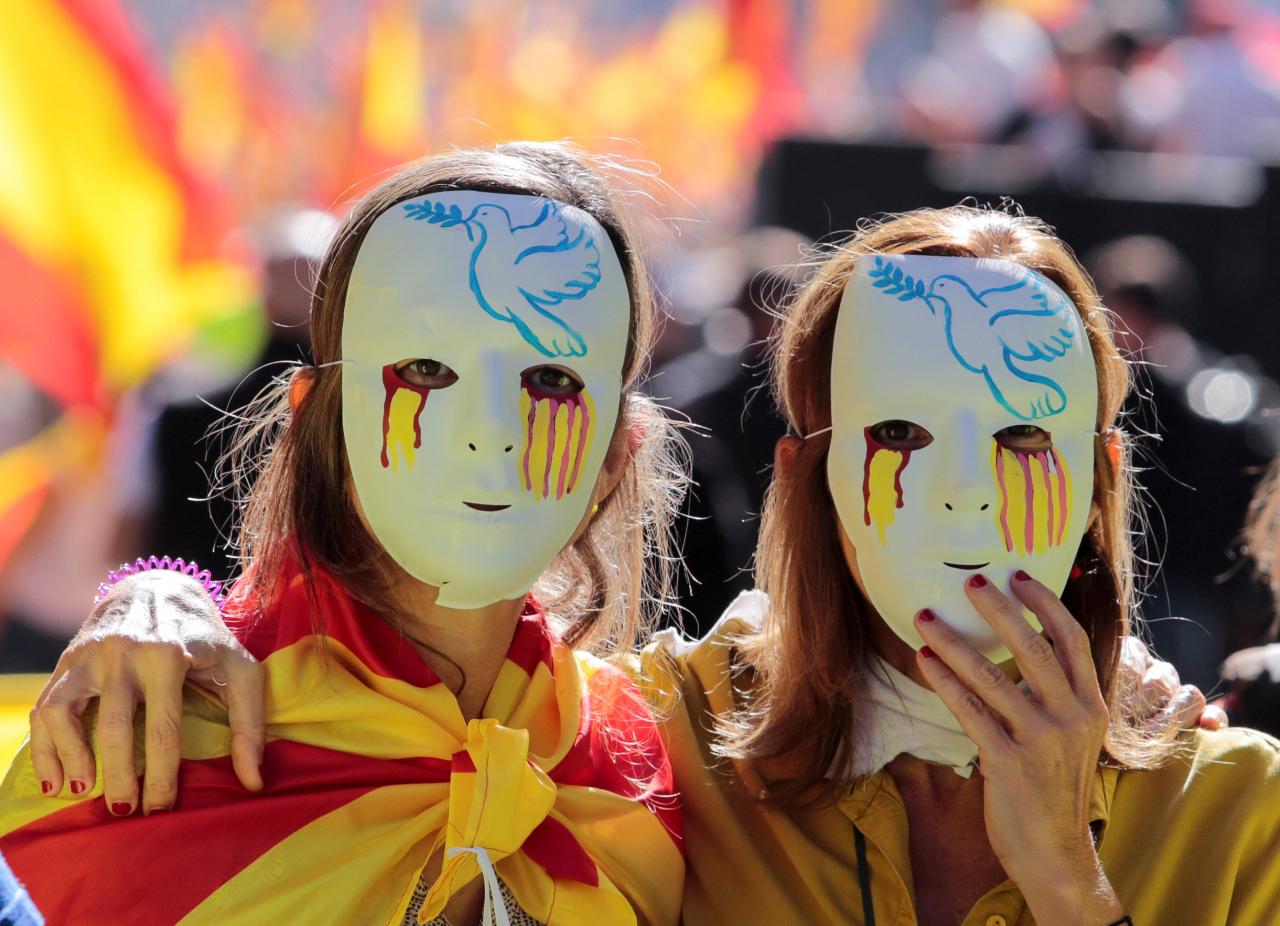
“Spain on a knife's edge as Madrid seizes control of rebel Catalonia” (Madrid, AFP)
Deja vu isn’t what it used to be. I am confused. Hasn’t
the Spanish Civil War ended? Here is a clue from the first paragraph of the AFP
news release under the headline above. “Spain
was plunged into crisis Friday as Madrid seized power from independence-seeking
Catalonia, the first curtailment of regional autonomy since the brutal
dictatorship of Francisco Franco.” Yes, let’s keep “the brutal dictatorship of
Francisco Franco” front and center when we talk about contemporary Spain. Here we
have the mass media slipping some virtue signaling into the mix to guide the
reader, historiographically speaking, through dark, turbulent waters toward the
safe harbor of cultural Marxist hermeneutics as he contemplates the current disorder.
AFP,
by the way, stands for Agence France-Presse, an international news agency headquartered in Paris and
the third largest news agency in
the world, after AP and Reuters. Those who gaze at the world under the
journalistic tutelage of the cognoscenti from AP, AFP and Reuters, should be
aware that “brutal dictatorship” is one of their well-worn meta-political
prescriptions, a de rigueur qualifier for right-wing dictators, living or dead.
Rarely or ever do they apply it to the “liberators” of the left who grant free
health care to their wards. In vein, you will scour AP or AFP coverage over the
decades to discover “the brutal dictatorship of Fidel Castro.” Rather, here is
another recent piece of left-wing journalism (the NYT) rhapsodic over a different Latin caudillo. “The Socialist-inspired movement
of the late President Hugo Chávez of Venezuela led to gains in education and
health care, but the country has sunk into hunger, unrest and dictatorship.” This “hunger, unrest and dictatorship” seems
to be quite the mystery. Take note of
how respectful this is – “the late President” … his “Socialist-inspired movement”
and so many “gains.”
The
Spanish Civil War remains the 20th century prototype of the trending
victim ideology. A lot of Franco’s victims were from Catalonia. Catalonia’s
secessionist ambitions were a big part of the civil war, and it was, both materially
and ideologically, the most vigorous region in opposition to the Nationalists.
It was also an anarchist stronghold and the place where George Orwell observed
for posterity in Homage to Catalonia the
crushing of the non-Stalinist left (POUM) by Stalin’s NKVD. Today it offers an
exotic fusion of hyper leftwing politics, academics and social justice activism.
Visited now it would be sort of like a Berkeley, Madison, Ann Arbor and San
Francisco all rolled together in a beautiful Mediterranean setting. Standing in front of Gaudi's Sagrada Familia you might think you had just dropped some acid. To see
today’s left rapidly decomposing, debauched pathologies proudly on an
in-your-face display, go to Barcelona – a depressing contrast to conservative,
still-somewhat-Catholic, Madrid.
However,
to answer the question posed above: Did the Spanish Civil War really end in
1939 when the Republicans surrendered and the shooting stopped? No. Two separate thoughts apply here. First,
it was a civil war and, unlike conventional wars where the losers sue for peace
and the winners, content with the terms, go home, the victors and the
vanquished (for the most part) have to live together – intimately in some
cases. The victors take their revenge, daily, in ways big and small. For the
vanquished, the experience of resentment that never ceases to fester and is
passed through the generations. Moreover, resentment, if properly nourished and
managed, can become a powerful political weapon. In Spain, it has. Flip Clausewitz and you have the current Spanish
Civil War as conducted by the Marxists: “Politics is the continuation of
war by other means.”
Second,
is that the Spanish Civil War is, perhaps, unique in the 20th
century as a political rebellion where the forces of reaction prevailed against
a well-organized, highly energized far-left terrorism supported by and aligned
with the liberal and left-wing elites in politics, the universities and haute
culture. Also unique is that the narrative of the Spanish Civil War that eventually
triumphed was produced and widely promulgated not by the winners (Francoists)
but by the losers (the left). Its success was due in large part to its simplicity as a tragic, but
inspirational morality play. The freedom-loving, democratically elected Republicans,
supported and defended by the International Brigades, succumbed to the tides of
Spanish fascism under the leadership of General Francisco Franco, goose
stepping in a junior partnership with Hitler and Mussolini.
This is
the widely promulgated Manichean version of the Spanish Civil War
– the forces of Good, advancing democracy, equality and freedom, confronting
Evil in the form of fascism with its instinctive brutality, militarist atavism
and racial bigotry. It is wonderfully free of any moral ambiguity – the losers
as heroes and martyrs in opposition to tyranny and oppression, abandoned by the
Western democracies; the winner, a cretin mediocrity who took his revenge,
built his dictatorship and finally drifted into senescence.
In 2012,
the British Marxist, Paul Preston, published a massive tomb, The Spanish Holocaust:
Inquisition and Extermination in Twentieth-Century Spain. Just the title
and sub-title alone are a vicious smear; of course, the Catholic Church meets Auschwitz.
Preston, a prolific and erudite Spanish Civil War historian, is widely read and
admired in Spain. His Spanish Holocaust, however, is in keeping with the
left’s reductio ad hitlerum approach to modern history. In the Prologue
he writes: “I thought long and hard about using the word ‘holocaust’ in the sub-title of
this book. I feel intense sorrow and outrage about the Nazis’ deliberate
attempt to annihilate European Jewry. I also feel intense sorrow and outrage
about the lesser but none the less, massive suffering undergone by the Spanish people
during the Civil War of 1936—9 and for several years thereafter, I could find
no other word that more that more accurately encapsulates the Spanish
experience than ‘holocaust’.” I also feel intense sorrow and outrage reading
this book, but many words could be found to show how tendentious, dishonest and
outrageous Preston’s choice for his title really is, but suffice it to say that
he is entirely consistent in playing the left’s tiresome game of the brown smear
and preserving the fiction of the Spanish Civil War as fascism crushing
democracy.
Relieved
of its romantic For Whom the Bell
Tolls mythology, however, the historiography of the Spanish Civil
War, thanks to the herculean labors of researchers like Burnett Bolloten and
Stanley Payne, gives way in large part to the contemplation of communist
(Stalinist) duplicity and treachery heavily cloaked in the rhetoric of
democracy, equality and freedom. While
contributing human and material assets to the Spanish Republicans ostensibly to
resist the fascist rebels, Stalin’s NKVD agents were moving through Spain
rounding up, torturing and murdering dissident communists, like Andreu Nin,
taking control of the Army and insinuating themselves deeply into positions of
governmental power. Stalin’s Trojan horse modus operandi in Spain was a dress
rehearsal for how the communists would operate to support the unfolding of
“democracy” in devastated counties like Bulgaria, Romania, Hungary and Poland
at the end of World War II, countries that we all know became models of social
equality and so bursting with confidence, prosperity and opportunity that no
one was allowed to leave.
During this
civil war, Stalin’s assassins were also chasing his former revolutionary
colleague, Leon Trotsky, around the globe and killing his family members until
the Soviet-trained Spaniard, Ramon Mercader, murdered him in Mexico City in
1940. Mercader’s mother, incidentally, was Caridad del Río Hernández, an ardent communist who fought in
the Spanish Civil War and doubled as a Soviet agent.The Leon Trotsky of Stalin’s
invention and dissemination was supposedly in league with Franco and the
fascists. In historical retrospect, it is difficult to conceive how such a preposterous
fiction could have taken hold with anyone, but Stalin’s dramaturgical skill in
service to his jealousy and megalomania was second only to the eager
gullibility of his acolytes and fellow travelers.
“Fascist”
in Stalin’s lexicon was his preferred term of abuse for whomever at the moment
he saw as a competitor for power, his enemy du jour. Stalinists reserve their
resentment for those who compete with them for power. Inside the Soviet Union
from 1936 through 1938, Stalin purged the bulk of the old Bolsheviks like
Bukharin and the senior officer corps, men who, like Trotsky, were supposedly
in league with the fascists. These were individuals, most of whom were deeply
committed communists, revolutionaries from the early days of the Bolshevik revolution.
But Stalin feared and loathed them because he viewed them as competitors for
his own power base within the party. Into Spain with the support of Santiago Carrillo
and his Spanish communist followers, he exported his signature calumnies,
purges, show trials with the accompanying tortures and executions. His agents
moved against Francisco Largo Caballero and the socialists with a ferocity and
ruthlessness that was directed against the forces of Franco in lesser
proportions. All of the non-Stalinist
left in Spain at one time or another during the civil war were linked to or
tarnished with the label of fascist.
With
“fascism” being so protean and flexible, how absurd to try to render the
Spanish Civil war as a battle of democracy against fascism when in many ways it
more resembles a replay of French Jacobins against the ancien régime. However,
the resemblance is imperfect. Franco did manage militarily to crush the Republicans
and punish and purge all the Spanish leftists he could get his hands on. He
also tried mightily to make 20th century Spain into an earlier
Catholic Spain, not exactly a strictly fascist sort of obsession, evidenced
also by his marginalizing of the Falange. But his 36 year-long “brutal
dictatorship” was largely a bust. The Spanish Jacobins came roaring back,
literally. After Franco’s death in 1975, the legendary Spanish Communist and
devout Stalinist, La Pasionaria, Deloris Ibárruri of “No pasarán” fame returned to Spain from exile in
the Soviet Union and eventually took an elected seat in the Spanish Parliament.
General Secretary of the Spanish Communist
Party (PCE) Santiago Carrillo also returned to Spain from the Soviet Union.
Carrillo, a Stalinist errand boy and butcher, had supervised the Paracuellos
massacres by a Republican faction in 1936. He also arranged for the murder of
those Spanish communists who had incurred Stalin’s disapproval. Back in
post-Franco Spain, Carrillo joined Ibárruri in Parliament. He was awarded an
honorary doctorate by the Autonomous University of Madrid in 2005. La Pasionaria
and Carrillo, both very old, with bloody hands and unrepentant, died, so to
speak, in the “odour of sanctity” in the crumbling remnants of Franco’s Spain.
Post-Franco,
it seemed like only minutes before Spain joined the rest of secularist,
consumerist, western Europe with all the once-forbidden goodies – liberated
women, no-fault divorce, gay rights, abortion (eventually). With the fading of a Catholic Spain and the
Iberian embrace of secular hedonism, you might think that the Spanish Marxists
would be happy. But, no. Leftists everywhere are unhappy and resentful. Resentment brings victims (as subjects of political
patronage) and targets victimizers (as objects of proscription and revenge). In
the U.S. the victims are “people of color” and the victimizers are white
racists, committed to the retention of their “privilege” and the pursuit of
their “supremacy.” In Spain, the left has Franco as the great victimizer,
having achieved, per Paul Preston, Hitler status. When you have yet another Hitler in place,
there are ample victims for consideration and no place to hide for those who
cannot quite grasp the new reality. Franco, unlike Hitler, won his war, and the
Spanish, unlike the post WWII Germans subjected to de-Nazification, have eluded
a de-Francoization. But the left persists. In 2007 the Socialist Party passed
the eerie sounding “Law of Historical Memory” which, formally condemned the
Franco regime and began the process of the dismantling of all things Franco in
Spain – statues, street names, etc. –
and someday, Franco’s memorial and tomb, Valle
de los Caidos. The Spanish Civil War is not over, at least not for the left
in Spain.


